Introduction
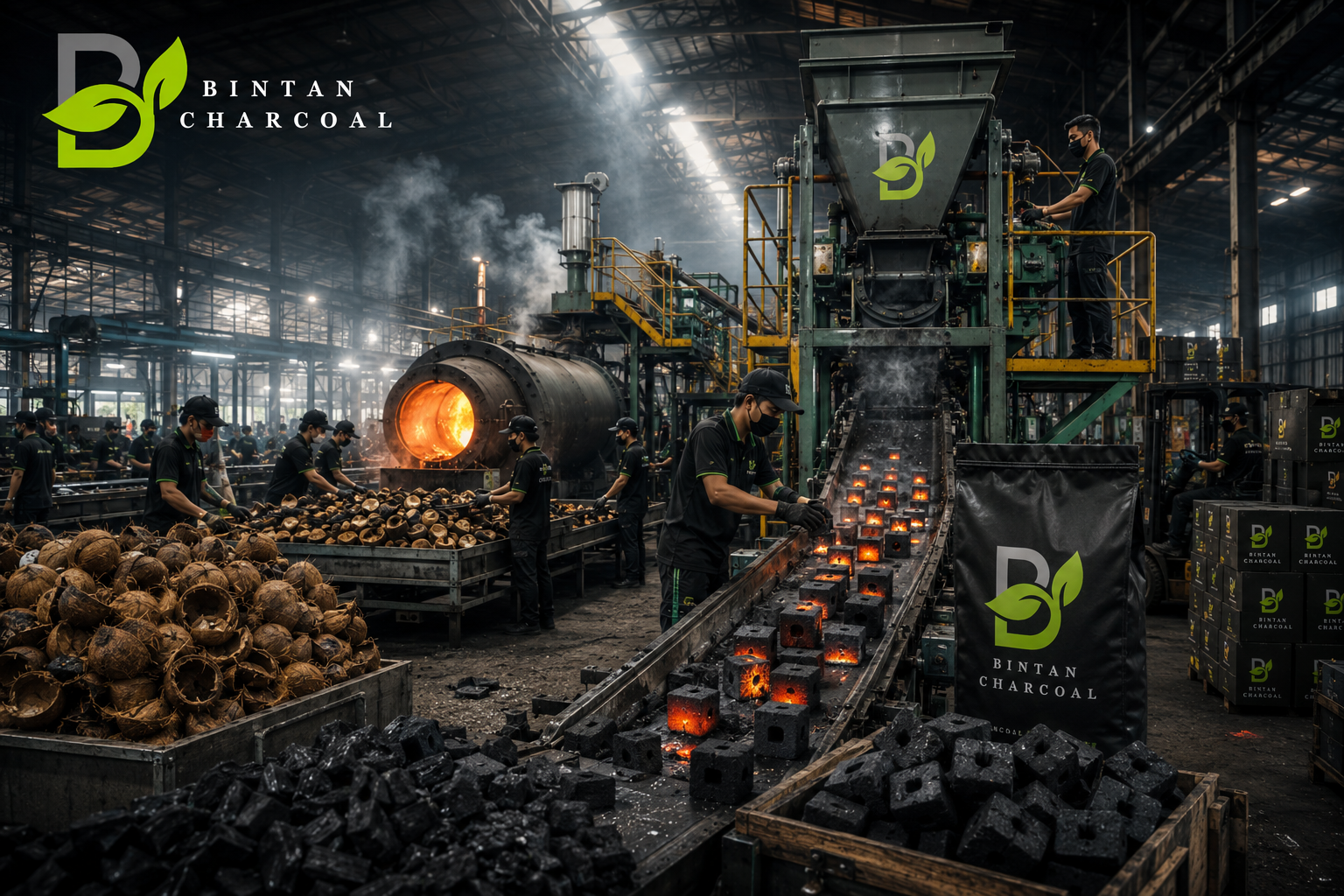
Have you ever wondered how premium shisha charcoal is made? From the moment a coconut shell is collected to the final packaging of export-ready briquettes, every stage plays a critical role in producing the high-performance charcoal used in hookah lounges and homes around the world.
Indonesia has earned its reputation as the global leader in coconut charcoal production thanks to abundant raw materials, advanced manufacturing technology, skilled labor, and strict quality control standards. Today, many international buyers rely on a trusted charcoal manufacturer in Indonesia to supply premium-quality products for the growing global shisha market.
In this article, we’ll take you inside an Indonesian charcoal factory and explore the complete journey from coconut shell to finished briquette.
Why Indonesia Leads the Charcoal Industry 🌍
Before exploring the production process, it’s important to understand why charcoal Indonesia dominates the global market.
Indonesia is one of the largest coconut-producing countries in the world. Millions of coconut shells are generated annually as a byproduct of the coconut industry. Instead of becoming waste, these shells are transformed into premium charcoal briquettes used for shisha, hookah, BBQ, and industrial applications.
The combination of abundant raw materials and experienced charcoal producers has helped establish Indonesia as the preferred sourcing destination for importers worldwide.
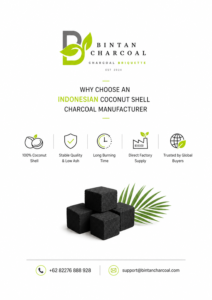
Today, many global buyers actively seek partnerships with Indonesia charcoal briquettes manufactures due to their reputation for quality, consistency, and reliable export services.
Step 1: Collecting Premium Coconut Shells 🥥
The process begins with raw material selection.
High-quality coconut shells are sourced from various regions across Indonesia. The quality of the final product largely depends on the quality of the coconut shells used during production.
Professional factories carefully inspect incoming materials to ensure they are:
✅ Clean
✅ Dry
✅ Free from contaminants
✅ Suitable for carbonization
This initial step lays the foundation for producing premium charcoal briquttes with superior performance characteristics.
Step 2: Carbonization Process 🔥
Once the coconut shells arrive at the factory, they undergo carbonization.
Carbonization is the process of converting coconut shells into charcoal by heating them in a controlled low-oxygen environment.
During this stage:
- Moisture is removed
- Organic compounds are reduced
- Carbon content increases
- Energy density improves
The result is high-quality coconut shell charcoal with excellent burning properties.
Experienced charcoal manufacturers carefully monitor temperature and timing throughout the carbonization process to achieve optimal charcoal quality.
Proper carbonization contributes to:
- Longer burning time
- Higher heat output
- Low ash production
- Cleaner combustion
These characteristics make Indonesian charcoal highly desirable in international markets.
Step 3: Crushing and Grinding the Charcoal
After carbonization, the charcoal is crushed into fine powder.
Modern factories use specialized machinery to ensure a consistent particle size. Uniform charcoal powder is essential for producing durable and high-performance briquettes.
At this stage, quality control teams inspect the material to ensure consistency before proceeding to the mixing process.
A professional shisha charcoal factory Indonesia understands that even minor variations in particle size can affect the final product’s quality.
Step 4: Mixing and Formulation ⚙️
The powdered charcoal is then combined with a natural binder.
Most premium factories use food-grade starch binders to maintain product safety and performance.
The mixture is carefully formulated to achieve:
- Strong briquette structure
- Consistent density
- Uniform heat output
- Reduced breakage during transportation
This stage is one of the most important steps in producing export-quality charcoal briquettes.
The precise formulation often distinguishes premium manufacturers from lower-quality suppliers.
Step 5: Briquette Pressing
Once the mixture is prepared, it is compressed into specific shapes using hydraulic or mechanical presses.
Popular export sizes include:
25mm Cube Briquettes
The most common size in the global hookah market.
26mm Cube Briquettes
Preferred by premium hookah lounges due to longer burning performance.
27mm Cube Briquettes
Ideal for extended smoking sessions.
Finger and Flat Briquettes
Designed for specialized market preferences.
A reliable shisha charcoal supplier can usually offer multiple sizes and custom specifications depending on customer requirements.
Step 6: Drying Process ☀️
Freshly pressed briquettes contain residual moisture that must be removed before packaging.
Factories use:
- Drying ovens
- Controlled drying chambers
- Solar drying systems
Proper drying is essential because excessive moisture can negatively affect:
- Ignition
- Burning performance
- Product durability
- Shelf life
Professional charcoal producers maintain strict moisture standards to ensure consistent product quality.
Step 7: Quality Control and Laboratory Testing 🔬
One of the defining characteristics of a reputable charcoal manufacturer is rigorous quality control.
Before packaging, samples are tested for:
Moisture Content
Ensures efficient ignition and stable burning.
Ash Content
Premium charcoal typically produces less than 2.5% ash.
Fixed Carbon
Higher fixed carbon generally results in better performance.
Burning Time
Verifies that products meet customer expectations.
Heat Output
Ensures consistent and reliable performance during use.
This quality control process helps maintain the reputation of Indonesian charcoal in international markets.
Step 8: Packaging and Export Preparation 📦
After passing inspection, the briquettes are packaged according to customer requirements.
Packaging options often include:
- Retail boxes
- Master cartons
- Private label packaging
- OEM branding solutions
A professional charcoal supplier & exporter understands the importance of secure packaging to prevent damage during international transportation.
Packaging quality is especially important when shipping products across long distances.
Step 9: Global Distribution 🚢
Once packaging is complete, the products are prepared for export.
An experienced charcoal exporter Indonesia handles:
- Export documentation
- Customs clearance
- Container loading
- International shipping coordination
Today, Indonesian charcoal is exported to:
- United Arab Emirates
- Saudi Arabia
- Germany
- France
- United Kingdom
- United States
- Canada
- Australia
- South Africa
This global reach demonstrates the strength of Indonesia’s charcoal export infrastructure.
Why Buyers Choose an Indonesian Charcoal Supplier
International buyers consistently choose an Indonesian charcoal supplier for several reasons:
Consistent Quality
Factories maintain strict production standards and quality control procedures.
Reliable Supply
Indonesia’s abundant coconut resources support year-round manufacturing.
Competitive Pricing
Local raw material availability helps reduce production costs.
Export Experience
Experienced suppliers understand international shipping requirements.
Private Label Services
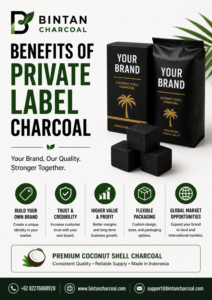
Many factories offer customized branding and packaging solutions.
These advantages make Indonesia the preferred destination for businesses seeking premium charcoal products.
Sustainability and Environmental Responsibility 🌱
One of the biggest benefits of coconut charcoal production is sustainability.
Unlike traditional wood charcoal, coconut shell charcoal utilizes agricultural waste that would otherwise be discarded.
Many Indonesia charcoal briquettes manufactures focus on:
- Renewable raw materials
- Waste reduction
- Efficient production methods
- Sustainable sourcing practices
This environmentally responsible approach appeals to modern businesses and consumers worldwide.
The Future of Charcoal Indonesia
As global demand for premium hookah products continues to grow, the future of charcoal Indonesia remains exceptionally strong.
Consumers increasingly prefer:
✅ Sustainable products
✅ Longer-burning charcoal
✅ Low-ash performance
✅ Natural raw materials
✅ Premium smoking experiences
These trends continue to drive demand for high-quality Indonesian coconut charcoal.
Conclusion
The journey from coconut shell to premium briquette is a carefully controlled process that requires expertise, technology, and strict quality standards.
From raw material selection and carbonization to pressing, drying, testing, and export preparation, every step contributes to producing world-class charcoal briquettes.
This commitment to quality is why importers worldwide trust Indonesian manufacturers, charcoal supplier & exporter companies, and experienced charcoal producers to meet their sourcing needs.
Whether you are searching for a reliable shisha charcoal supplier, evaluating a shisha charcoal factory Indonesia, or looking for a trusted charcoal exporter Indonesia, understanding the manufacturing process can help you make informed purchasing decisions and secure long-term business success.
Indonesia’s combination of abundant coconut resources, modern production facilities, and export expertise continues to make it the world’s leading producer of premium coconut charcoal briquettes. 🔥🌍
Frequently Asked Questions
What makes Indonesian charcoal different?
Indonesian coconut charcoal offers longer burning time, higher heat output, and lower ash content compared to many alternative charcoal products.
Why do buyers choose a charcoal exporter Indonesia?
Buyers benefit from reliable supply chains, export experience, competitive pricing, and premium product quality.
What is the role of a shisha charcoal factory Indonesia?
A professional factory manages the complete production process from carbonization and pressing to testing, packaging, and export preparation.
Are charcoal briquettes environmentally friendly?
Yes. Coconut charcoal briquettes are produced from renewable coconut shell waste, making them a more sustainable alternative to wood charcoal.
How do I find a trusted Indonesian charcoal supplier?
Look for manufacturers with proven export experience, quality certifications, strong production capacity, and transparent quality control procedures.