FOB vs CIF for Coconut Shell Charcoal
When importing coconut shell charcoal briquettes from Indonesia, one of the most important decisions is choosing the right shipping term.
Two of the most commonly used Incoterms for international container shipments are FOB (Free On Board) and CIF (Cost, Insurance and Freight).
Understanding FOB vs CIF for Coconut Shell Charcoal helps importers, distributors, and private-label brands understand who is responsible for freight arrangements, insurance, and different parts of the transportation process.
For first-time buyers, CIF may appear easier. For experienced importers with their own freight forwarder or preferred shipping arrangements, FOB may offer greater control.
What Is FOB?
FOB stands for Free On Board.
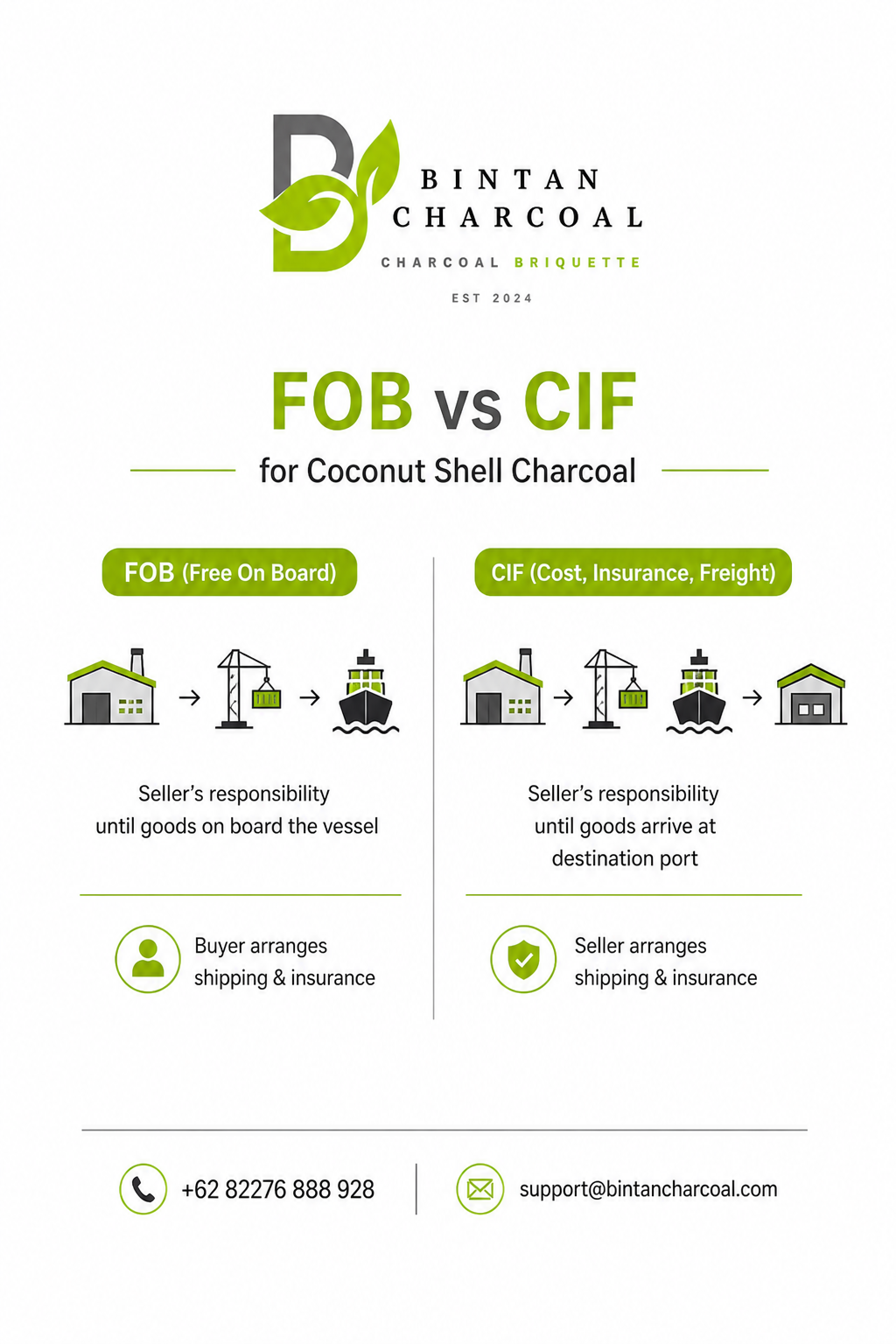
Under FOB, the seller is responsible for preparing and delivering the cargo for export and loading it on board the vessel at the agreed port of shipment.
For example:
FOB Surabaya, Indonesia
The Indonesian charcoal manufacturer handles the production and export preparation until the goods are loaded on board the vessel at the agreed port.
After the goods are on board, the buyer takes responsibility for the main transportation and related arrangements.
Under FOB, the Seller Typically Handles:
- Charcoal production
- Quality control
- Export packaging
- Transportation to the port
- Export customs clearance
- Loading the goods on board the vessel
Under FOB, the Buyer Typically Arranges:
- Ocean freight
- Cargo insurance
- Destination charges
- Import customs clearance
- Import duties and taxes
- Inland transportation at destination
What Is CIF?
CIF stands for Cost, Insurance and Freight.
Under CIF, the seller arranges and pays for the main ocean freight and minimum required cargo insurance to the agreed destination port.
For example:
CIF Jebel Ali, UAE
The Indonesian charcoal supplier & exporter arranges shipment from Indonesia to Jebel Ali and includes the agreed freight and insurance in the quoted CIF price.
However, an important point is that paying freight to the destination does not mean the seller is responsible for every cost after arrival.
The buyer may still need to pay destination charges, import duties, taxes, customs clearance, and local transportation.
FOB vs CIF: The Main Difference
| FOB | CIF |
|---|---|
| Buyer arranges ocean freight | Seller arranges ocean freight |
| Buyer arranges cargo insurance | Seller arranges required minimum insurance |
| Buyer has more shipping control | Seller provides a simpler shipping arrangement |
| Freight is paid separately | Freight is included in the CIF quotation |
| Often suitable for experienced importers | Often convenient for first-time importers |
| Buyer chooses the forwarder or carrier | Seller arranges the shipment |
The most important difference is who arranges and pays for the main ocean freight to the destination port.
FOB Example for Coconut Shell Charcoal
Imagine you purchase a 40ft container of coconut shell charcoal from Indonesia.
The supplier quotes:
FOB Surabaya: USD 1,700 per MT
You purchase:
25 MT
Product Value
25 MT × USD 1,700 = USD 42,500
You then arrange your own:
- Ocean freight
- Cargo insurance
- Destination handling
- Import clearance
The advantage is that you can compare freight quotations from different forwarders and shipping lines.
CIF Example for Coconut Shell Charcoal
Now imagine the supplier offers:
CIF Destination Port: USD 1,900 per MT
For 25 MT:
25 MT × USD 1,900 = USD 47,500
The CIF quotation includes:
- Product
- Export arrangements
- Ocean freight
- Required cargo insurance
However, you should still ask the supplier and your destination agent about charges that may apply after the container arrives.
Which Is Better for First-Time Charcoal Importers?
For a first-time importer, CIF can be more convenient.
The supplier handles the main shipping arrangement, meaning the buyer does not need to negotiate directly with multiple freight companies.
CIF may be suitable if you:
- Are importing for the first time
- Do not have a freight forwarder
- Want the supplier to arrange the main shipment
- Prefer a simpler quotation
However, you should always check the expected destination charges before confirming a CIF shipment.
Which Is Better for Experienced Importers?
FOB can be attractive for experienced importers.
FOB may be suitable if you:
- Already have a freight forwarder
- Have a preferred shipping line
- Can negotiate competitive freight rates
- Want more control over shipping
- Regularly import containers
Many established distributors prefer FOB because they can manage their own logistics.
Important: CIF Does Not Mean Everything Is Included ⚠️
A common misunderstanding is believing that CIF means the seller pays every cost until the charcoal reaches the buyer’s warehouse.
This is not correct.
CIF normally covers the cost of goods, freight to the agreed destination port, and the required insurance under the CIF term.
The buyer may still be responsible for costs such as:
- Destination terminal charges
- Port handling charges
- Import customs clearance
- Import duty
- VAT or other taxes
- Delivery from the port to the warehouse
- Container detention or demurrage, where applicable
Before placing an order, always ask your local customs broker or freight agent for estimated destination costs.
FOB vs CIF: Risk Transfer
Another important difference is when risk transfers from seller to buyer.
Under both FOB and CIF, the seller’s delivery obligation and risk transfer generally occur when the goods are loaded on board the vessel at the port of shipment.
This means that even under CIF, where the seller pays for freight and insurance to the destination port, the seller does not necessarily carry the transportation risk all the way to the destination.
This is an important reason why buyers should understand the Incoterm rather than simply looking at whether freight is included in the price.
Which Shipping Term Should You Choose?
Choose FOB if:
- You have your own freight forwarder
- You want to compare shipping prices
- You import regularly
- You want more control over logistics
Choose CIF if:
- You are a first-time importer
- You do not have a freight agent
- You prefer the supplier to arrange the ocean shipment
- You want a simpler shipping arrangement
The best option depends on your logistics experience and the destination country.
FOB and CIF for Shisha Charcoal Containers 🚢
For a full-container shipment of charcoal briquettes, buyers should also discuss:
- Container size
- Total net weight
- Packaging configuration
- Port of loading
- Destination port
- Production lead time
- Shipping schedule
- Freight validity
- Cargo insurance
- Destination charges
A 20ft or 40ft container may have different loading capacities depending on the charcoal size and packaging.
For example, Bintan Charcoal typically works with:
- 20ft container: approximately 17.5–18 MT
- 40ft HQ container: approximately 25–26 MT
The final loading weight can vary depending on packaging requirements and product specifications.
Questions to Ask Before Choosing FOB or CIF
Before confirming your coconut charcoal order, ask:
1. What is the FOB price?
Confirm the exact port, for example:
FOB Surabaya, Indonesia
2. What is the CIF price?
Confirm the exact destination port.
3. Which charges are not included?
Always clarify destination charges separately.
4. What shipping line will be used?
Ask about the proposed carrier and estimated transit time.
5. What insurance is included?
Ask what type and level of cargo insurance is arranged.
6. How long is the freight quotation valid?
Ocean freight can change depending on shipping market conditions.
Why Work with an Experienced Charcoal Exporter Indonesia?
International shipping requires coordination between production, packaging, export documentation, container loading, and freight arrangements.
An experienced charcoal exporter Indonesia can help buyers prepare for shipment by coordinating:
- Production
- Quality control
- Packaging
- Container loading
- Export documentation
- Shipping arrangements
Bintan Charcoal is a professional Indonesian charcoal manufacturer specializing in coconut shell charcoal briquettes for the international shisha market.
We work with importers, distributors, wholesalers, and private-label brands and can discuss suitable shipping arrangements based on the buyer’s destination and logistics requirements.
Conclusion
Understanding FOB vs CIF for Coconut Shell Charcoal is important before placing an international order.
FOB gives buyers more control over freight and logistics, making it suitable for experienced importers with their own forwarders.
CIF can provide a simpler arrangement because the seller organizes and pays for freight and required insurance to the agreed destination port.
However, CIF does not mean that every destination cost is included.
Before confirming your order, always clarify the agreed Incoterm, named port, shipping costs, insurance, destination charges, and import responsibilities.
For coconut shell charcoal importers, working with a professional charcoal supplier & exporter can make the export process smoother and help ensure that your charcoal briquettes are properly prepared for international shipment.
🔥🥥 Whether you choose FOB or CIF, clear communication about shipping responsibilities is essential for a successful charcoal import.