
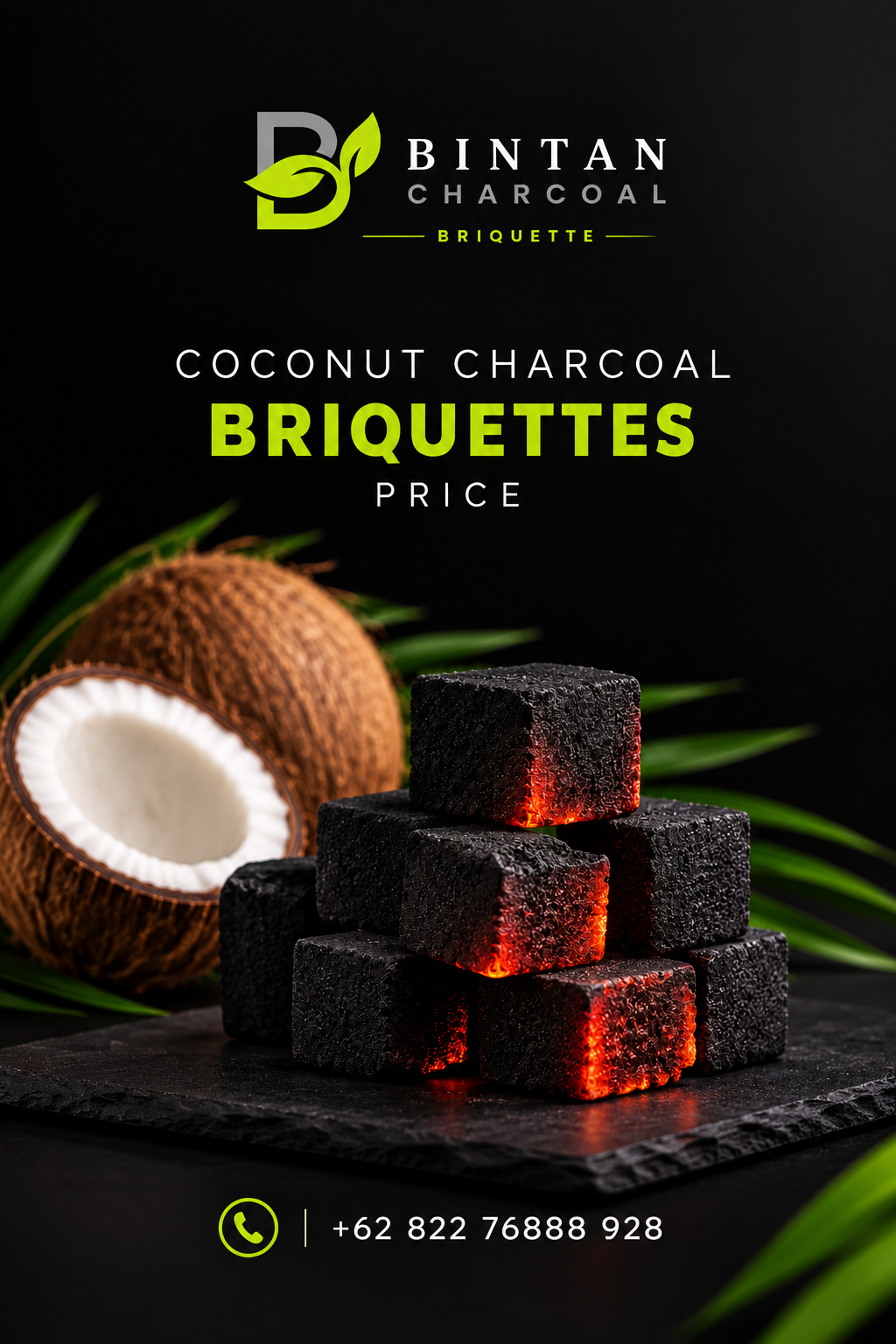
When searching for coconut charcoal briquettes price, buyers often find that prices vary significantly between suppliers. The final cost depends on several factors, including charcoal quality, raw materials, production capacity, packaging, order quantity, shipping, and the destination country.
For importers, wholesalers, distributors, hookah businesses, and BBQ suppliers, understanding these factors can make it easier to compare offers and choose the right supplier.
What Determines Coconut Charcoal Briquettes Price?
The price of coconut charcoal briquettes is not determined by one factor alone. Suppliers consider production costs, product specifications, packaging, and logistics when calculating their wholesale price.
Here are some of the most important factors.
1. Charcoal Quality
Quality is one of the biggest factors affecting the price of coconut charcoal briquettes.
Premium briquettes are generally manufactured to provide characteristics such as:
- High fixed carbon
- Low ash content
- Low moisture
- Consistent density
- Stable heat
- Long burning time
- Minimal smoke and odor
- Uniform size and shape
Higher-quality products may have a higher purchase price, but they can offer better performance and customer satisfaction.
2. Ash Content
Ash content is particularly important for hookah and shisha charcoal.
Lower-ash briquettes are generally more desirable because they leave less residue after burning. Suppliers producing consistently low-ash charcoal may have higher processing and quality-control costs.
When comparing coconut charcoal briquettes price, buyers should therefore compare product specifications rather than looking only at the quoted price per kilogram.
3. Order Quantity
Wholesale order volume can have a significant effect on the unit price.
A small trial order may have a higher price per kilogram than a full container order because production, packaging, handling, and logistics costs are distributed across fewer products.
For larger orders, buyers may be able to negotiate better pricing with the manufacturer or exporter.
4. Packaging
Packaging requirements can also influence the final price.
Common options include:
- Bulk cartons
- Retail boxes
- Inner boxes
- Printed packaging
- Customized branding
- Private-label packaging
Standard packaging is usually more economical, while customized packaging may increase the total cost because of printing, design, materials, and minimum order requirements.
5. Briquette Shape and Size
Coconut charcoal briquettes are available in different shapes and sizes depending on their intended application.
For hookah and shisha, common shapes include cubes and other standardized forms. BBQ charcoal may use different shapes depending on the market and application.
Special sizes or customized specifications may affect production costs and therefore the final coconut charcoal briquettes price.
6. Shipping and Destination
The supplier’s quoted price may not include transportation costs.
For international buyers, the total landed cost can include:
- Product price
- Packaging
- Inland transportation
- Port handling
- Export documentation
- Ocean freight
- Import duties
- Destination charges
This is why buyers should compare the complete landed cost rather than comparing supplier prices alone.
How Much Do Coconut Charcoal Briquettes Cost?
There is no single global price for coconut charcoal briquettes. Wholesale prices change according to quality, market conditions, order quantity, packaging, origin, and shipping terms.
Instead of relying on a generic online price, importers should request a current quotation based on their exact requirements.
When requesting a quotation, provide information such as:
- Required quantity
- Briquette size
- Desired ash percentage
- Moisture specification
- Packaging type
- Private-label requirements
- Delivery destination
- Preferred shipping terms
This allows suppliers to provide a much more accurate price.
Wholesale vs. Retail Coconut Charcoal Briquettes Price
Retail charcoal is normally more expensive per kilogram than wholesale charcoal because retail pricing includes additional costs such as consumer packaging, distribution, warehousing, marketing, and retailer margins.
Wholesale buyers purchasing directly from manufacturers may receive more competitive pricing, particularly when ordering larger quantities.
However, the cheapest quotation is not necessarily the best deal.
A low-priced product may have higher moisture, inconsistent density, excessive ash, shorter burning time, or inconsistent sizing.
How to Compare Coconut Charcoal Briquettes Suppliers
When comparing different suppliers, create a simple comparison based on both price and specifications.
For example:
| Factor | Supplier A | Supplier B | Supplier C |
|---|---|---|---|
| Price per kg | Compare | Compare | Compare |
| Ash content | Compare | Compare | Compare |
| Moisture | Compare | Compare | Compare |
| Fixed carbon | Compare | Compare | Compare |
| Briquette size | Compare | Compare | Compare |
| Packaging | Compare | Compare | Compare |
| MOQ | Compare | Compare | Compare |
| Production capacity | Compare | Compare | Compare |
| Shipping cost | Compare | Compare | Compare |
This approach gives buyers a better understanding of the actual value of each offer.
Request a Sample Before a Large Order
Before committing to a large shipment, it is recommended to test a product sample.
Testing can help evaluate:
- Ignition
- Burning time
- Heat consistency
- Ash production
- Smoke
- Odor
- Briquette durability
- Size consistency
A sample can also help you determine whether the product meets the expectations of your customers.
Coconut Charcoal Briquettes Price for Export
For international buyers, export pricing should be discussed together with shipping terms.
Suppliers may provide quotations based on different Incoterms, depending on the transaction. Buyers should make sure they understand exactly what is included in the quoted price.
For example, ask whether the quotation includes transportation to the port, export documentation, loading, and other relevant charges.
Understanding the quotation terms can prevent unexpected costs later.
Tips for Getting a Better Wholesale Price
If you are looking for competitive coconut charcoal briquettes price, consider the following strategies.
Order in Larger Quantities
Larger orders can sometimes provide better unit pricing because production and handling costs can be spread across a greater volume.
Use Standard Packaging
If you do not require customized branding, standard packaging can help reduce packaging costs.
Build a Long-Term Supplier Relationship
Regular orders may allow buyers and suppliers to establish better commercial terms over time.
Compare Total Landed Cost
Don’t compare only the factory price. Consider freight, packaging, duties, and other logistics expenses.
Test Quality First
Always make sure the product meets your specifications before focusing solely on price.
Why Cheap Coconut Charcoal Briquettes May Not Be the Best Choice
A very low price can sometimes indicate differences in raw material quality, production processes, or product specifications.
For example, charcoal with excessive ash or moisture may appear cheaper but provide inferior performance.
For distributors and retailers, poor-quality charcoal can also result in customer complaints and damage to the reputation of the brand.
The goal should therefore be to find the best value, rather than simply the lowest price.
Conclusion
The coconut charcoal briquettes price you receive will depend on product quality, order quantity, packaging, specifications, production costs, and shipping requirements.
For wholesale and export buyers, the best approach is to request current quotations from several suppliers and compare both price and product specifications.
Before placing a large order, request samples, confirm quality requirements, clarify packaging, and calculate the complete landed cost. This can help you find a reliable supplier offering competitive pricing and consistent coconut charcoal briquettes.
If you are planning to purchase coconut charcoal briquettes in bulk, provide your required quantity, specifications, packaging requirements, and destination to the supplier so they can prepare an accurate quotation.