
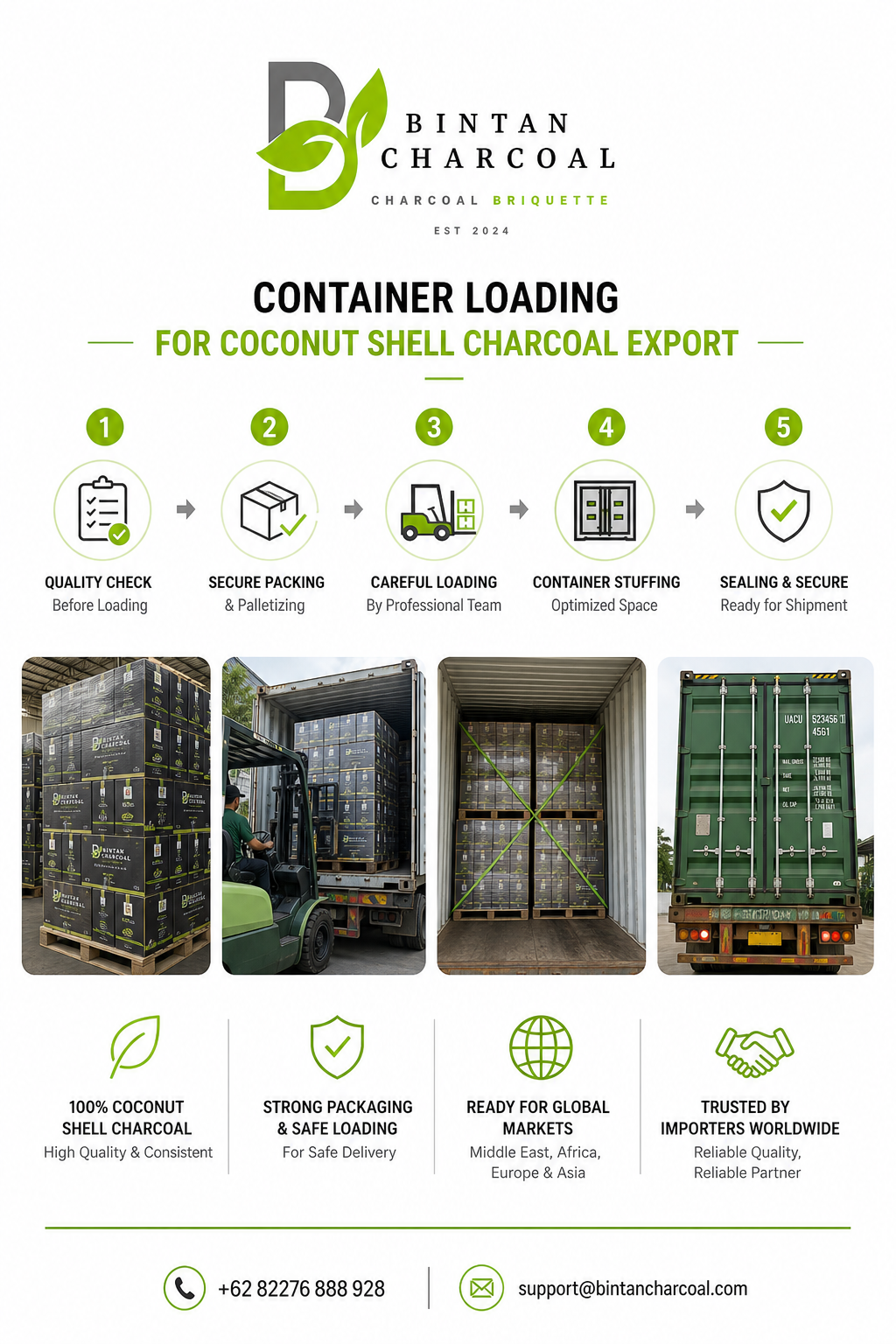
Container Loading for Coconut Shell Charcoal Export
For international buyers purchasing coconut shell charcoal briquettes from Indonesia, container loading for coconut shell charcoal export is an important part of the supply process.
Producing premium charcoal is only one part of a successful export shipment. The charcoal must also be properly packed, inspected, loaded, documented, and secured before the container leaves the factory.
For importers, distributors, wholesalers, and private-label brands, proper container loading can help reduce product damage, packaging problems, and unnecessary delays during transportation.
A professional charcoal manufacturer should have a clear loading procedure from the moment the finished briquettes are ready until the container is sealed.
Why Proper Container Loading Matters
Coconut shell charcoal briquettes can travel thousands of kilometers before reaching the final buyer.
During transportation, the cargo may experience:
- Handling
- Vibration
- Container movement
- Loading and unloading
- Port operations
- Long-distance ocean transportation
Poor loading practices can increase the risk of:
- Broken briquettes
- Damaged boxes
- Crushed cartons
- Contaminated products
- Incorrect quantities
- Packaging damage
Proper preparation helps protect the cargo throughout the export journey.
Step 1: Complete Production Before Loading
Container loading should only begin after the required production quantity is ready.
A professional shisha charcoal factory Indonesia normally checks the finished product before it is packed for export.
Important checks may include:
- Charcoal size
- Briquette shape
- Physical condition
- Moisture
- Ash specification
- Packaging
- Quantity
For private-label orders, the manufacturer should also verify that the correct branding and packaging have been prepared.
Step 2: Quality Control Before Shipment 🔬
Pre-shipment quality control is important before loading the container.
The manufacturer may inspect the charcoal for:
Dimensions
The briquettes should match the agreed size.
Common shisha sizes include:
- Cube 22mm
- Cube 25mm
- Cube 26mm
- Cube 27mm
- Finger Hexagonal
Physical Condition
Briquettes should be checked for excessive cracks, breakage, or other visible defects.
Moisture
Moisture should be checked against the agreed product specification.
Laboratory Testing
Depending on the buyer’s requirements, laboratory analysis may include:
- Ash
- Moisture
- Fixed carbon
- Volatile matter
A reliable charcoal supplier & exporter should be able to explain the quality specifications agreed for the shipment.
Step 3: Packaging the Coconut Charcoal 📦
Packaging is extremely important for international shipments.
The packaging should protect the charcoal from:
- Physical damage
- Moisture
- Dust
- Contamination
- Excessive handling
Different buyers may request different packaging configurations.
Full Packaging
A common retail configuration is:
- 1kg inner box
- Inner plastic packaging
- 10kg master box
This option is suitable for brands selling directly to retail customers.
Bulk Packaging
Another option is:
- 1kg inner plastic
- 10kg master box
- No inner retail box
This can reduce packaging costs while still providing individual 1kg units.
Bulk Loose Packaging
For larger wholesale operations:
- 10kg inner plastic
- 10kg master box
The best packaging depends on the buyer’s target market and distribution model.
Packaging can also be customized to 250g, 500g, or 1kg formats.
Step 4: Checking the Master Cartons
Before loading, master cartons should be inspected.
The factory should verify:
- Correct carton size
- Correct product
- Correct quantity
- Correct branding
- Proper sealing
- No significant carton damage
For OEM and private-label orders, this step is especially important because incorrect packaging can affect the entire shipment.
Step 5: Preparing the Container 🚢
Before loading begins, the container should be inspected.
The loading team should check the general condition of the container, including:
- Cleanliness
- Dryness
- Floor condition
- Walls
- Ceiling
- Doors
- Odors
- Visible damage
The container should be suitable for the cargo before any charcoal is loaded.
Step 6: Loading the Charcoal
Once the container has been inspected, the master cartons are loaded systematically.
The loading team should aim to:
- Use available space efficiently
- Maintain stable cargo positioning
- Avoid crushing cartons
- Prevent unnecessary movement
- Keep the cargo properly organized
The exact loading arrangement depends on:
- Container size
- Carton dimensions
- Packaging type
- Total cargo weight
- Palletization requirements
Not every shipment will have the same loading pattern.
How Much Coconut Charcoal Fits in a Container?
Container capacity depends on the charcoal size, packaging, carton dimensions, and loading method.
Typical loading figures used for Bintan Charcoal shipments include approximately:
20ft Container
17.5–18 metric tons
40ft High Cube Container
25–26 metric tons
These figures are approximate and should not be treated as a universal loading standard.
The actual quantity should be confirmed based on the final packaging configuration and shipping requirements.
Why Packaging Affects Container Capacity
Two containers carrying the same charcoal product may have different loading quantities because of packaging.
For example, retail boxes can take up more space than bulk packaging.
The final loading capacity can therefore be influenced by:
- Inner box size
- Master carton dimensions
- Number of units per carton
- Pallet usage
- Product size
- Container type
This is why importers should confirm the expected net and gross weight before finalizing an order.
Step 7: Counting and Recording the Cargo
Accurate quantity control is essential.
Before the container is sealed, the loading team should record:
- Number of cartons
- Number of inner boxes
- Product size
- Total net weight
- Total gross weight
- Packaging configuration
This information should correspond with the commercial and shipping documents.
For international buyers, accurate documentation can make customs clearance and cargo verification easier.
Step 8: Taking Loading Photos and Videos 📸
Many international buyers cannot physically visit the factory during container loading.
Loading photos and videos can therefore be useful for communication and shipment records.
Photos may show:
- Empty container
- Product before loading
- Packaging
- Loading process
- Finished loading
- Container doors
- Container number
- Container seal
This provides buyers with additional visibility into the shipment preparation process.
Step 9: Container Sealing
After loading is completed, the container doors are closed and sealed.
The seal number should be recorded as part of the shipment documentation.
The buyer may use the container number and seal information to identify the shipment during transportation.
Step 10: Export Documentation
After loading, the charcoal exporter Indonesia prepares or coordinates the required export documentation.
Depending on the shipment and destination, documents may include:
- Commercial Invoice
- Packing List
- Bill of Lading
- Certificate of Origin
- Certificate of Analysis
- Other documents required by the destination
The exact documents depend on the destination country, buyer requirements, shipping arrangement, and applicable regulations.
FOB vs CIF Container Loading
The loading process at the factory can be similar under both FOB and CIF shipments.
The main difference is generally the responsibility for the main ocean freight arrangement.
FOB
The buyer normally arranges the main ocean freight after the seller fulfills its FOB delivery obligations.
CIF
The seller arranges the main ocean freight and the required minimum insurance to the named destination port.
Regardless of the Incoterm, buyers should clearly agree on:
- Port of loading
- Destination port
- Container type
- Cargo weight
- Shipping schedule
- Documentation
- Freight responsibilities
Dangerous Goods and Charcoal Export
Importers should also confirm the current transportation and documentation requirements for charcoal before shipment.
Depending on the charcoal product, carrier, route, and applicable regulations, special requirements may apply.
Shipping lines and destination authorities can have specific procedures for charcoal cargo.
Therefore, buyers should work with an experienced charcoal exporter Indonesia and confirm the requirements with the relevant carrier and freight forwarder before loading.
Common Container Loading Mistakes
Several problems can be avoided through proper planning.
1. Loading Damaged Cartons
Damaged packaging can become worse during transportation.
2. Incorrect Quantity
Incorrect carton counts can create discrepancies between the physical shipment and shipping documents.
3. Poor Weight Distribution
Cargo should be loaded with appropriate consideration for weight distribution and container requirements.
4. Inadequate Moisture Protection
Charcoal packaging should be suitable for the intended transportation and storage conditions.
5. Incorrect Product Size
For mixed or multiple-size orders, each product should be clearly identified.
6. Incorrect Private-Label Packaging
OEM shipments require careful checking to prevent packaging errors.
Container Loading for Private Label Charcoal
Private-label orders require additional attention because the charcoal carries the buyer’s own brand.
Before loading, the manufacturer should verify:
- Brand name
- Logo
- Packaging design
- Product size
- Weight per package
- Carton quantity
- Master carton markings
A packaging mistake can affect an entire container, so final inspection is essential.
What Buyers Should Confirm Before Loading
International buyers should confirm the following before their container is loaded:
Product
- Charcoal type
- Size
- Shape
- Product specifications
Packaging
- Inner packaging
- Inner box
- Master carton
- Branding
Quantity
- Number of cartons
- Net weight
- Gross weight
- Container capacity
Quality
- Inspection
- Laboratory testing
- COA, if required
Shipping
- Incoterm
- Port of loading
- Destination port
- Shipping line
- Estimated departure
Documents
- Invoice
- Packing list
- Bill of Lading
- Certificate of Origin, if required
- Other destination-specific documents
Why Choose Bintan Charcoal for Coconut Charcoal Export?
Bintan Charcoal is an Indonesian charcoal manufacturer specializing in coconut shell charcoal briquettes for the international shisha market.
We supply:
- Cube 22mm
- Cube 25mm
- Cube 26mm
- Cube 27mm
- Finger Hexagonal
- Customized sizes
Our services are suitable for:
- Importers
- Distributors
- Wholesalers
- Hookah businesses
- Private-label brands
As a charcoal supplier & exporter, Bintan Charcoal focuses on production, quality control, packaging, and export preparation for international customers.
Our packaging options can include 250g, 500g, 1kg, bulk packaging, and customized private-label packaging.
Conclusion
Container Loading for Coconut Shell Charcoal Export is an important stage in the international supply chain.
A successful shipment requires more than simply putting cartons into a container. Product quality, packaging, container condition, loading arrangement, quantity verification, documentation, and shipping requirements should all be carefully managed.
For importers, choosing an experienced charcoal manufacturer and charcoal supplier & exporter can make the export process easier and more reliable.
Whether you are purchasing a standard product, wholesale charcoal briquettes, or developing your own private-label brand, proper container preparation helps protect your investment from the factory to the destination port.
For businesses sourcing charcoal Indonesia, working with a professional shisha charcoal factory Indonesia can provide better communication, production control, and export coordination.
🔥🥥 From factory production to container loading, every step matters when exporting premium coconut shell shisha charcoal.