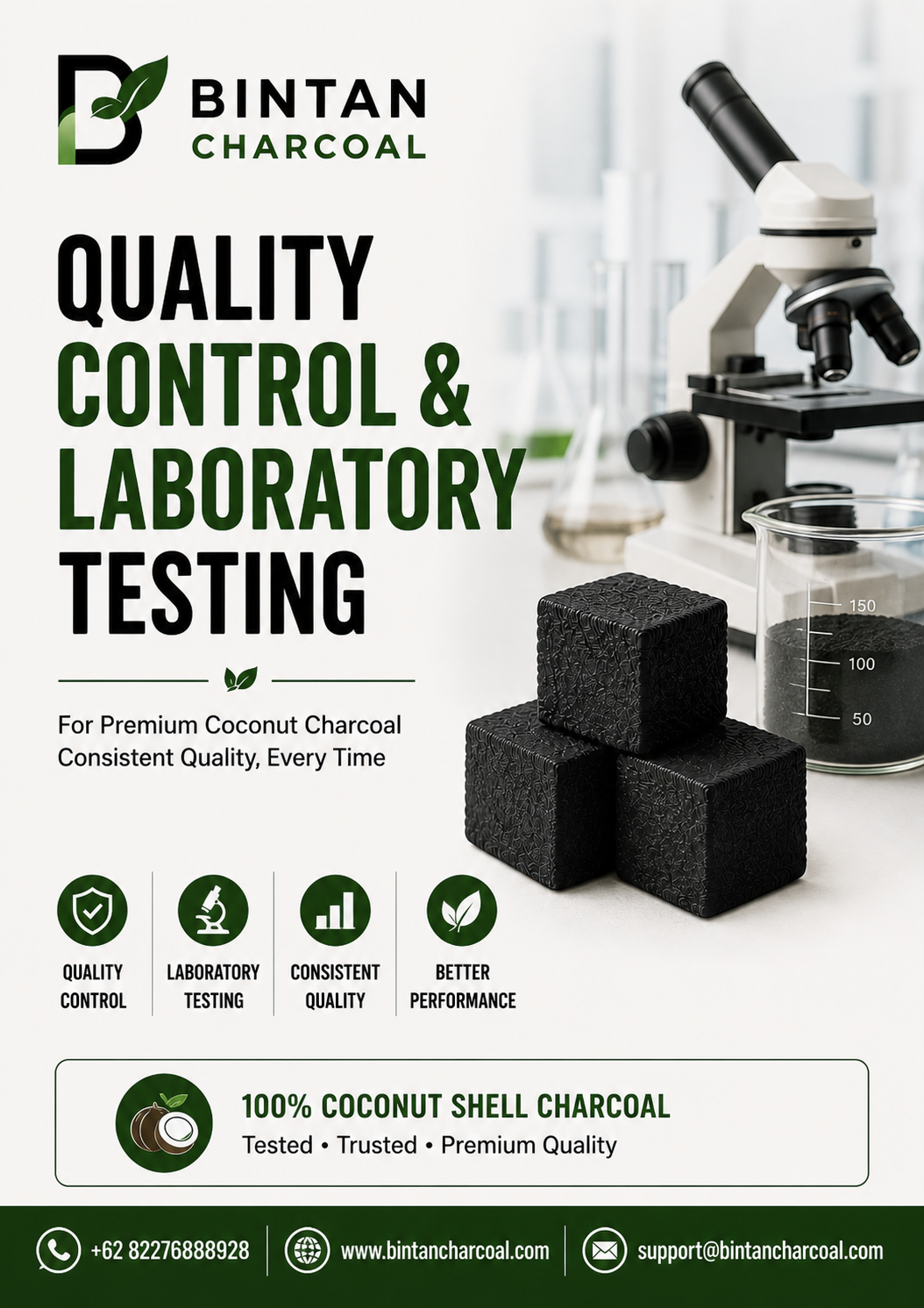
Quality Control & Laboratory Testing for Coconut Charcoal
For international buyers, quality is one of the most important factors when purchasing coconut shell charcoal briquettes. A product may look good on the outside, but without proper inspection and laboratory testing, it can be difficult to confirm whether the charcoal meets the required specifications.
This is why Quality Control & Laboratory Testing for Coconut Charcoal is an essential part of professional shisha charcoal manufacturing.
A reliable charcoal manufacturer should control product quality from raw material selection until the finished charcoal is packed and prepared for shipment. For importers, distributors, wholesalers, and private-label brands, consistent testing helps reduce the risk of receiving products that do not meet agreed specifications.
Why Quality Control Is Important for Coconut Charcoal 🏭
Coconut shell charcoal goes through several manufacturing stages before becoming finished shisha briquettes.
Quality problems can occur at different stages, including:
- Poor raw materials
- Inconsistent carbonization
- Incorrect particle size
- Poor mixing
- Inconsistent pressing
- Incorrect drying
- Weak briquettes
- Excessive moisture
- High ash
- Packaging damage
Without proper quality control, these problems may not be identified before shipment.
A professional shisha charcoal factory Indonesia should therefore inspect the product throughout the production process—not only at the end.
Quality Control Starts with Raw Materials 🌴
Premium charcoal briquettes begin with suitable raw materials.
For coconut shisha charcoal, the quality of the coconut shell charcoal used during production can influence the final product’s performance.
A professional indonesian charcoal supplier should monitor:
- Raw material cleanliness
- Consistency
- Contamination
- Carbonization quality
- Charcoal particle condition
Using inconsistent raw materials can make it difficult to maintain the same quality from one production batch to another.
Quality Control During the Manufacturing Process
Quality control should continue throughout every production stage.
1. Carbonization Control
Carbonization converts coconut shells into charcoal.
The process affects important characteristics such as:
- Fixed carbon
- Volatile matter
- Ash
- Combustion performance
Poor carbonization can result in inconsistent charcoal quality.
2. Grinding and Particle Size
The charcoal must be processed into a suitable particle size before briquette production.
Consistent particle processing can help manufacturers produce briquettes with a more uniform structure.
3. Mixing Control
The mixture should be prepared consistently before pressing.
Poor mixing can lead to variations in briquette strength and combustion performance.
4. Briquette Pressing
The pressing process affects:
- Density
- Shape
- Dimensions
- Strength
- Durability
A professional charcoal manufacturer should monitor the pressing process to help ensure that the briquettes maintain consistent specifications.
5. Drying Control
Moisture is another important characteristic of finished charcoal.
If moisture is too high, it may affect:
- Ignition
- Combustion
- Storage
- Product stability
Proper drying helps manufacturers maintain a more consistent finished product.
What Is Laboratory Testing for Coconut Charcoal? 🔬
Laboratory testing measures specific characteristics of charcoal using defined testing methods.
Instead of relying only on visual inspection, laboratory testing can provide measurable information about the product.
Important tests for coconut shell charcoal may include:
- Ash content
- Moisture content
- Fixed carbon
- Volatile matter
Other quality evaluations may include:
- Density
- Dimensions
- Physical strength
- Breakage resistance
- Burning performance
The exact specifications should be agreed between the buyer and the charcoal supplier & exporter before production begins.
Ash Content Testing
Ash content is an important quality characteristic for shisha charcoal.
After the charcoal burns, mineral residues remain as ash.
High ash can create:
- More cleaning
- Ash accumulation
- Heat-management challenges
- Customer dissatisfaction
Premium coconut shell charcoal is often selected for its ability to provide relatively low ash when properly manufactured.
However, buyers should request actual specifications rather than relying only on general marketing claims.
Moisture Content Testing 💧
Moisture can affect the way charcoal performs.
Excessive moisture may make charcoal:
- Harder to ignite
- Less efficient during combustion
- More difficult to store
Moisture testing helps the shisha charcoal supplier verify whether the finished product meets the agreed specification before shipment.
Packaging also plays an important role in protecting the charcoal from moisture during storage and transportation.
Fixed Carbon Testing 🔥
Fixed carbon is another commonly measured characteristic of charcoal.
Carbonization quality influences the amount of fixed carbon present in the charcoal.
Higher fixed carbon alone does not automatically guarantee that a charcoal briquette will be better. Buyers should evaluate fixed carbon together with:
- Ash
- Moisture
- Density
- Briquette strength
- Burning performance
A professional charcoal manufacturer evaluates the complete product rather than focusing on only one laboratory result.
Volatile Matter Testing
Volatile matter refers to components released from charcoal when heated under specific testing conditions.
Laboratory analysis of volatile matter can provide additional information about the carbonization and composition of the charcoal.
Together with ash, moisture, and fixed carbon, it helps provide a broader picture of charcoal quality.
Physical Quality Control 📏
Laboratory testing is important, but physical inspection is also necessary.
A professional shisha charcoal factory Indonesia should inspect:
Briquette Dimensions
Each charcoal piece should meet the required size.
For example:
- Cube 22mm
- Cube 25mm
- Cube 26mm
- Cube 27mm
- Finger Hexagonal
Consistent dimensions help customers achieve more predictable heat management.
Cracks and Breakage
Finished charcoal should be inspected for visible cracks and damage.
Strong briquettes are important because international transportation can cause breakage.
Density
Density can influence:
- Burn performance
- Heat stability
- Briquette strength
- Durability
Consistent density is important for maintaining consistent product performance.
Burning Performance Testing 🔥
Laboratory results provide measurable specifications, but practical performance testing can also be valuable.
Burning tests may evaluate:
- Ignition characteristics
- Heat stability
- Burning duration
- Ash appearance
- Briquette integrity during burning
Testing conditions should be defined clearly because results can vary depending on:
- Charcoal size
- Number of pieces
- Airflow
- Burner type
- Heat management
- Testing environment
For this reason, buyers should understand how a supplier measures burn time before comparing results.
Why Batch Testing Matters
A common mistake is assuming that one good laboratory result guarantees the quality of every future shipment.
Raw materials and production conditions can vary.
Batch testing helps manufacturers monitor production consistency.
For importers and distributors, batch-level quality control can help reduce the risk of significant variations between orders.
This is especially important for private-label brands because customers expect consistent performance every time they purchase the product.
Quality Control Before Shipment 🚢
Before a container is shipped, the finished charcoal should be inspected against the agreed order specifications.
Pre-shipment checks may include:
- Product size
- Packaging
- Quantity
- Physical condition
- Moisture
- Laboratory specifications
- Carton condition
A professional charcoal exporter Indonesia should confirm that the final shipment matches the buyer’s agreed requirements.
Why Quality Control Protects Your Business
For distributors and brand owners, poor-quality charcoal can create significant costs.
Potential problems include:
- Customer complaints
- Product replacements
- Refunds
- Negative reviews
- Lost customers
- Damage to brand reputation
A reliable charcoal supplier & exporter understands that quality control protects both the manufacturer and the buyer.
This is why the lowest price should not be the only factor when choosing a supplier.
Questions to Ask Your Coconut Charcoal Supplier
Before placing a large order, ask:
1. What laboratory tests do you perform?
Ask about ash, moisture, fixed carbon, and other relevant specifications.
2. Can you provide a Certificate of Analysis (COA)?
A COA can provide information about the tested production batch.
3. How often do you perform testing?
Ask whether testing is performed regularly or by production batch.
4. How do you inspect finished charcoal?
Ask about physical inspection, dimensions, breakage, and packaging checks.
5. What happens if a batch does not meet the agreed specification?
A professional manufacturer should have procedures for handling non-conforming products.
Why Choose Bintan Charcoal? 🥥
Bintan Charcoal is a professional charcoal manufacturer specializing in coconut shell charcoal briquettes for the international shisha market.
As an experienced:
- Charcoal manufacturer
- Charcoal supplier & exporter
- Shisha charcoal supplier
- Indonesian charcoal supplier
- Charcoal exporter Indonesia
- Shisha charcoal factory Indonesia
Bintan Charcoal focuses on quality control throughout production and performs inspections and laboratory testing before shipment.
Our quality control process focuses on important characteristics such as:
- Raw material quality
- Ash
- Moisture
- Fixed carbon
- Briquette dimensions
- Physical condition
- Product consistency
- Packaging quality
For international buyers, consistent quality is essential for building a successful long-term charcoal business.
Quality Control for OEM and Private Label Charcoal 📦
OEM and private-label customers require additional consistency.
When a distributor sells charcoal under its own brand, every shipment should meet the same agreed specifications.
Professional quality control helps OEM customers maintain:
- Consistent product performance
- Consistent charcoal size
- Consistent packaging
- Consistent quality specifications
This is essential for building customer trust and encouraging repeat purchases.
Conclusion
Quality Control & Laboratory Testing for Coconut Charcoal are essential for producing reliable premium shisha charcoal.
From coconut shell selection and carbonization to briquette pressing, drying, physical inspection, laboratory analysis, and pre-shipment checks, every stage can affect the final product.
For importers and distributors, choosing a professional charcoal manufacturer means looking beyond price.
Ask about laboratory testing, quality control procedures, batch consistency, physical inspection, and pre-shipment checks.
By working with an experienced charcoal supplier & exporter, shisha charcoal supplier, and reliable shisha charcoal factory Indonesia, businesses can reduce sourcing risks and build a stable supply of premium charcoal briquettes.
For companies looking for reliable charcoal Indonesia products, proper testing and consistent quality control are among the most important foundations of long-term success. 🔥🥥