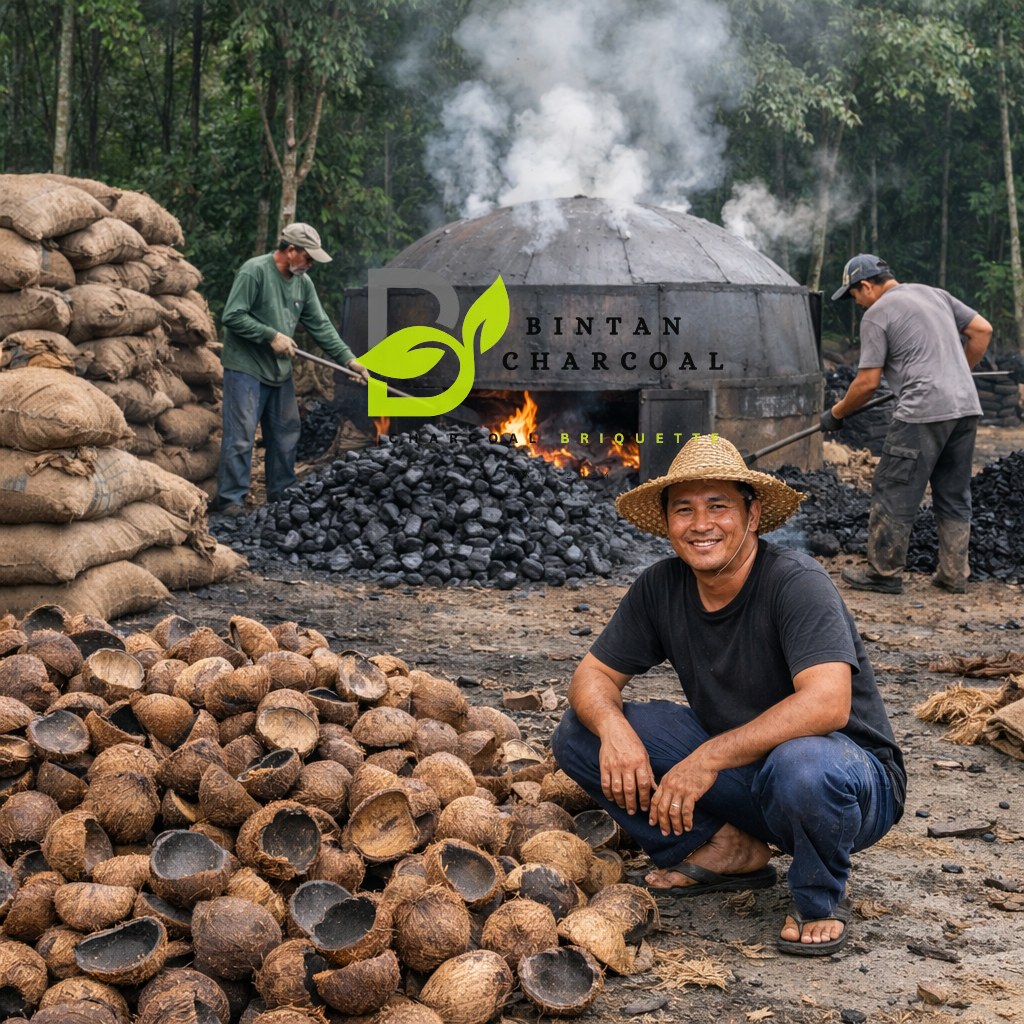
Producing high-quality charcoal briquettes starts with one critical stage: carbonization. This process determines the burn time, ash level, heat stability, and overall performance of the final product.
For any professional charcoal manufacturer, mastering carbonization is the key to delivering export-grade charcoal indonesia that meets international standards. 🌍
In this article, we break down the complete carbonization process used by leading indonesia charcoal briquettes manufactures to produce premium coconut shell charcoal.
🌴 1. Raw Material Selection – The Foundation of Quality
Everything begins with selecting high-density coconut shells. A reliable indonesian charcoal supplier ensures that only mature, thick shells with low moisture content are used.
Quality raw material must have:
- Low initial moisture
- Thick shell structure
- Minimal contamination
- Proper drying before burning
Professional charcoal producers understand that poor shell quality results in weak charcoal briquttes, unstable heat, and higher ash content.
🔥 2. Pre-Drying Process
Before carbonization, coconut shells are naturally dried under the sun or using controlled drying systems.
هدف this stage:
- Reduce moisture content
- Ensure uniform burning
- Increase carbon yield
- Improve final briquette strength
For a serious charcoal supplier & exporter, moisture control is essential to meet export specifications.
🔥 3. Controlled Carbonization (Pyrolysis Process)
Carbonization is the process of heating coconut shells in a low-oxygen environment. This process removes volatile compounds and transforms the shell into high-carbon charcoal.
Modern shisha charcoal factory Indonesia facilities use:
- Traditional drum kilns (small scale)
- Brick kilns (medium scale)
- Continuous carbonization furnaces (large export scale)
The key factors monitored by a professional charcoal manufacturer include:
- Temperature control (400–700°C)
- Oxygen limitation
- Burning duration
- Smoke emission management
Proper control ensures:
✔ High fixed carbon content
✔ Low ash percentage
✔ No cracks or over-burned charcoal
✔ Clean-burning charcoal briquettes
🌫 4. Cooling Process
After carbonization, the charcoal must cool naturally in a sealed environment to prevent oxidation.
If exposed to oxygen too quickly, the charcoal can:
- Crack
- Turn into ash
- Lose fixed carbon value
Experienced charcoal producers follow strict cooling protocols to maintain premium quality for global markets.
🧪 5. Crushing & Screening
Once cooled, the charcoal is crushed into fine powder. The powder is then screened to remove:
- Oversized particles
- Impurities
- Dust contamination
This stage ensures consistency for shaping uniform charcoal briquttes.
A reliable charcoal exporter indonesia prioritizes uniform mesh size to guarantee stable briquette density and burn performance.
🏭 6. Mixing & Briquette Forming
The charcoal powder is mixed with natural binders (usually food-grade starch). No harmful chemicals are added.
This mixture is then pressed into shapes such as:
- Cube (25mm / 26mm)
- Hexagonal
- Finger size
Premium shisha charcoal supplier factories use high-pressure hydraulic machines to produce:
- Strong structure
- Crack-free surface
- Long-lasting burn
- Minimal ash residue
This stage transforms carbonized material into export-ready charcoal briquettes.
🔥 7. Final Drying & Quality Control
After molding, briquettes are oven-dried to reduce moisture below international standards (usually under 5%).
Professional indonesia charcoal briquettes manufactures perform laboratory testing for:
- Fixed carbon content
- Ash percentage
- Moisture level
- Burn time
- Drop test durability
Only after passing strict quality checks can the product be shipped by a certified charcoal supplier & exporter.
🌍 Why Carbonization Determines Export Quality
The carbonization process directly impacts:
- Burn time (2+ hours for premium grade)
- Heat stability
- Low ash (under 2.5%)
- No sparks
- No odor
These qualities are essential for hookah markets. That is why every professional shisha charcoal factory Indonesia invests heavily in advanced carbonization technology.
For global buyers, partnering with an experienced indonesian charcoal supplier ensures consistent performance and reliable supply.
♻ Sustainable & Eco-Friendly Production
Coconut shell carbonization is environmentally responsible because:
- It uses agricultural waste
- No trees are cut down
- Emissions can be controlled
- Waste heat can be recycled
Modern charcoal indonesia production focuses on sustainable practices to meet global environmental expectations. 🌱
⭐ Conclusion
The complete carbonization process is the backbone of premium charcoal briquettes production. From raw shell selection to controlled pyrolysis, cooling, crushing, and final molding — every step determines product excellence.
A professional charcoal manufacturer understands that precision in carbonization builds long-term trust in international markets.
By working with experienced charcoal producers and a reliable charcoal exporter indonesia, global distributors can secure high-performance charcoal briquttes that deliver clean heat, long burn, and consistent quality. 🔥🌍
In the world of charcoal indonesia, perfection begins in the carbonization chamber.